
Mezzanine Financing Options for Acquisition, Expansion or Growth
When Senior Debt Doesn’t Get You All the Way There
Mezzanine financing can help bridge the gap when senior debt does not provide enough capital to complete an acquisition, expansion, or growth plan.
Lendway Capital Advisors helps established businesses and acquisition buyers structure mezzanine financing when additional capital is needed behind the senior debt.
Typical Mezzanine Financing Profile
$3 Million and Up
Loan AmountsUsually Over $2 Million
EBITDAGenerally .75X–1.25X
Maximum Debt-to-EBITDA RatioAcquisition, Expansion, or Growth
UsesSubordinate to Senior Debt
PositionUsually Interest Only
PaymentsUsually Five Years or More
MaturityCan Be Unsecured
CollateralWhat Is Mezzanine Financing?
Mezzanine financing is a loan that sits behind senior debt and can provide additional capital when there is a shortfall in the overall financing structure. Think of it as another layer in the capital stack: Senior Debt > Mezzanine Financing > Equity
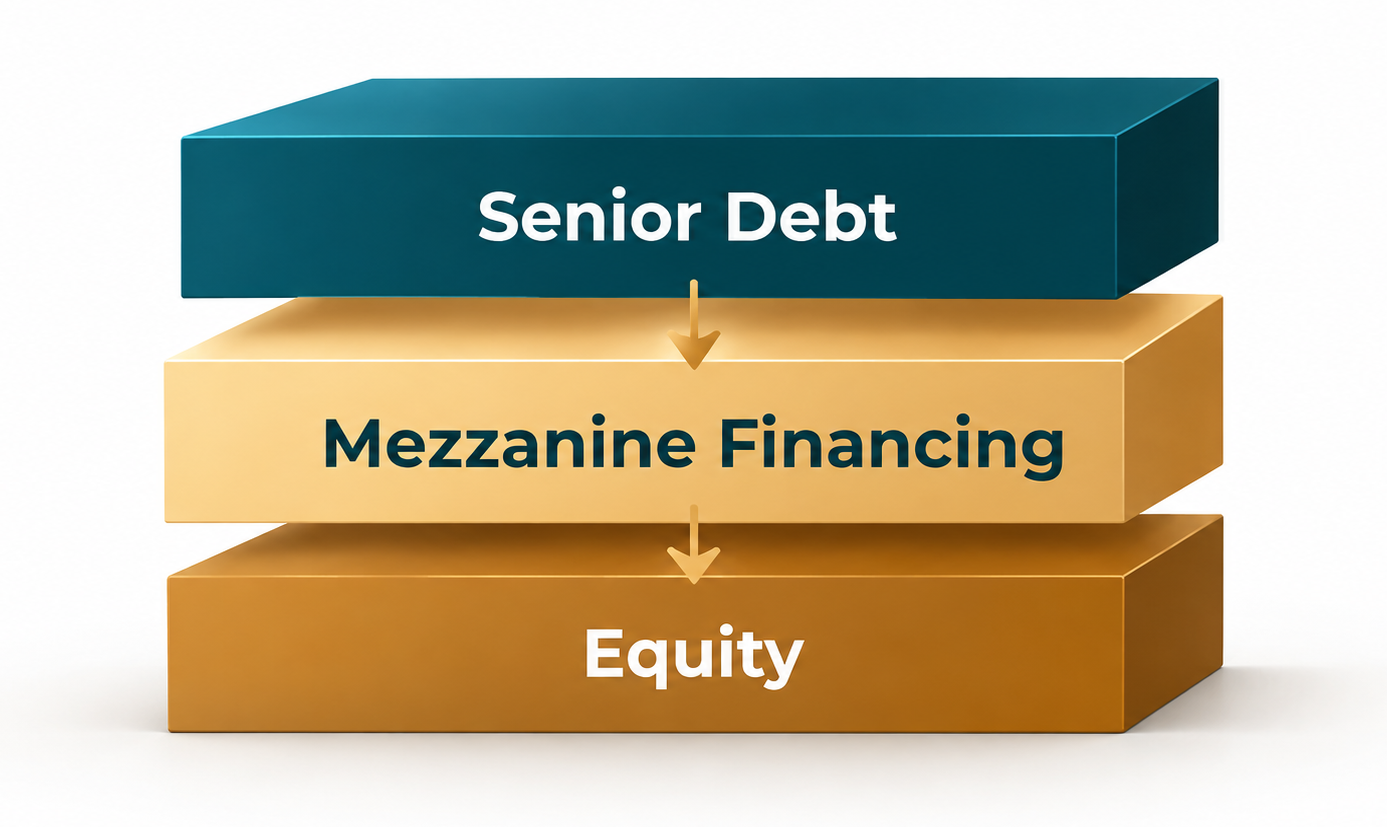
The senior lender gets paid first. The mezzanine loan sits behind that senior debt but ahead of preferred and common stock.
Because of that subordinate position, mezzanine debt will usually carry a higher yield than ordinary debt. However, it can give a business access to additional capital without having to raise the entire shortfall by giving up equity.
When Does Mezzanine Financing Make Sense?
We focus on mezzanine financing for three specific situations:Business Acquisitions
You found the company you want to buy. The numbers make sense. Senior financing is available.
There is just one problem.
The senior debt does not cover the entire transaction.
A mezzanine loan can sit behind that senior debt and help bridge the remaining financing gap without requiring you to raise all of the additional capital through equity.
Business Expansion
Maybe your company is ready for its next phase, but the capital required to execute the expansion exceeds what your senior financing source is willing to provide.
If the business has the EBITDA to support additional debt, mezzanine financing may provide another layer of capital to help move the expansion forward.
Business Growth
Growth takes money.
When an established business has a legitimate opportunity to grow but needs more capital than it can obtain through senior debt alone, mezzanine financing can provide additional funding without diluting the company’s ownership.
What Does a Typical Mezzanine Loan Look Like?
Mezzanine financing is not designed for every company. The businesses we look at for this type of financing will generally have more than $2 million in EBITDA, with financing needs beginning around $3 million and up. The exact maturity will often depend on the company’s existing debt schedule and how the overall financing is structured.
| Financing Consideration | Typical Mezzanine Structure |
|---|---|
| Loan Size | $3 Million and Up |
| EBITDA | Usually Over $2 Million |
| Maximum Debt-to-EBITDA Ratio | Generally .75X–1.25X |
| Primary Uses | Acquisition, Expansion, or Growth |
| Debt Position | Subordinate to Senior Debt |
| Collateral | Can Be Unsecured |
| Payments | Usually Interest Only |
| Principal | Typically Paid at Maturity |
| Maturity | Usually Five Years or More |
Why Use Mezzanine Financing Instead of Raising More Equity?
This is where mezzanine financing becomes interesting. You need more capital. So you basically have a decision to make.
Do you borrow it, or do you sell part of the company to get it?
Mezzanine financing can be more expensive than ordinary senior debt, but it is generally cheaper than raising equity and does not dilute the company’s ownership.
If your business continues to grow, the percentage of the company you give away today could become much more valuable tomorrow.
With mezzanine debt, you are using financing to fill the capital gap rather than automatically turning to outside equity.
Mezzanine Financing vs. Raising Equity
| Mezzanine Financing | Raising Equity |
|---|---|
| Uses debt to raise additional capital | Raises capital by selling ownership |
| No dilutive effect on company equity | Dilutes existing ownership |
| Generally cheaper than raising equity | Can become expensive as company value grows |
| Existing owners maintain their equity | New investors receive part of the company |
| Financing has to be repaid | Equity does not have scheduled principal repayment |
| Structure may give the lender some control | Investors receive ownership rights |
How Are Mezzanine Loan Payments Structured?
One of the advantages of mezzanine financing is its structural flexibility.
These loans will usually have interest-only payments, with the principal balance paid at maturity rather than being paid down through a traditional amortization schedule.
Some mezzanine financing structures can also provide additional flexibility with the interest itself.

The Pros and Cons of Mezzanine Financing
There is no perfect financing structure. Mezzanine financing gives businesses access to additional capital and can help protect ownership, but you are taking on subordinate debt at a higher cost than traditional senior financing. You need to look at both sides.
| Pros | Cons |
|---|---|
| Generally cheaper than raising equity | Higher interest rates than ordinary debt |
| No dilutive effect on company equity | May include restrictions on taking on additional credit |
| Flexible financing structure | Structure may provide the lender with some control |
| May be unsecured | Principal still has to be repaid |
| Usually interest-only during the loan term | Large principal balance may remain at maturity |
| Interest may be deferred in some structures | Deferred interest increases the outstanding balance |
| Interest payments are tax deductible | Adds additional debt to the company's capital structure |
The real question is not whether mezzanine financing is “good” or “bad.” Does the structure make sense for the company and what you are trying to accomplish?
Is Your Business a Fit for Mezzanine Financing?
You are acquiring an established business.
Your existing company is expanding or growing.
EBITDA is usually over $2 million.
You need $3 million or more in financing.
Senior debt does not cover the entire capital requirement.
You want to avoid giving up equity to raise the remaining capital.
The company can support additional debt.
A subordinate financing structure can work alongside the senior debt.

Don't Look at the Mezzanine Loan by Itself
This is important. A mezzanine loan is only one part of the financing structure.
If you are buying a business, expanding an existing company, or raising capital for growth, we need to look at the entire capital stack and determine how the pieces work together.
01.
How much senior debt is involved?
02.
How much mezzanine financing is needed?
03.
How much equity is going into the transaction?
04.
Does the business have enough EBITDA to support the total debt?
05.
What does the existing debt schedule look like?
These pieces cannot be analyzed independently. The whole structure has to work.
At Lendway Capital Advisors, our job is to help evaluate the transaction, structure the financing request, and determine whether mezzanine financing can realistically fill the gap.
We are not interested in forcing a financing product into a deal where it does not belong.