
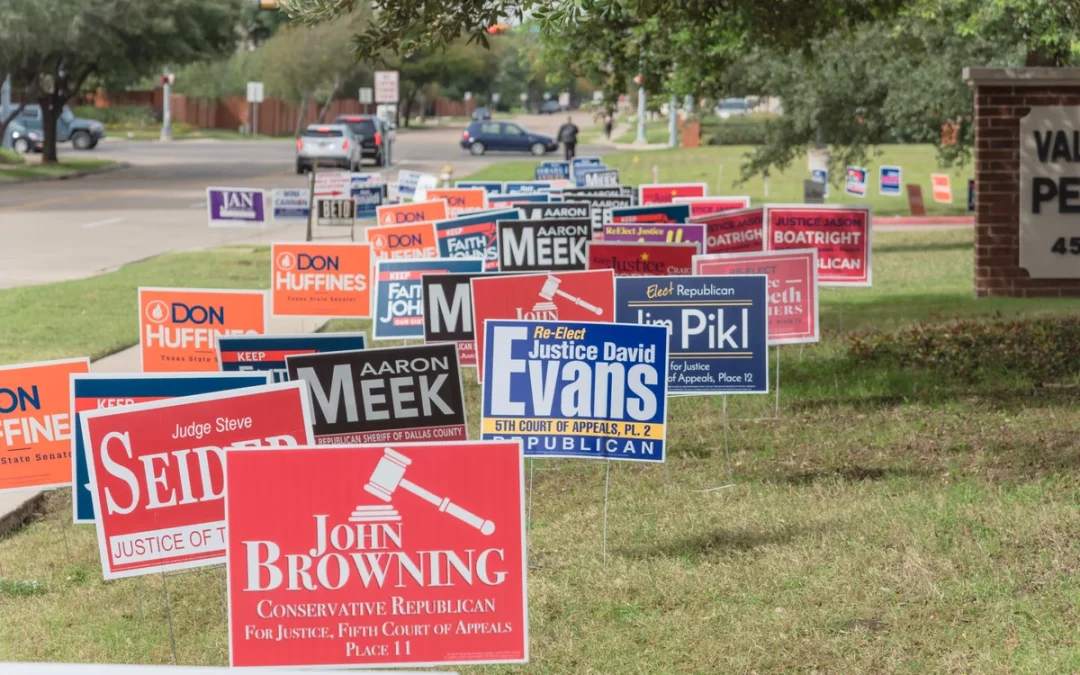
This was a very interesting business, as its main source of revenue is designing and printing election signs for political candidates. You know, those signs your neighbors put on their front yards every election, and you have to take extra special care in the morning as you leave for work to not back your car into one of them. You actually can’t drive 100 feet without passing 17 of them around election time probably no matter where you are in the country.
EXECUTIVE SUMMARY: This business had inconsistent revenue because its main source of income was tied to election cycles. A few banks shied away from the deal, but the inconsistency made total sense, the buyers were strong, and we were able to put together a financing structure that worked.
The Problem With Inconsistent Revenue
The problem is that elections are not every year. 2025 has almost no elections for any political positions and then 2026 will have a ton of new elections. So you have to figure a business whose main source of revenue is dependent on these elections would struggle in the non-election years and thrive in the election years. That is exactly what this business has to contend with.
Why Some Banks Backed Away
Now, banks like consistency year in and year out. They don’t want to deal with downtrends and uptrends in revenue, so you can understand why a few of them shied away from this particular scenario.
That is exactly why not every deal fits neatly into the same box. Sometimes there is an obvious reason why the numbers move around, and when there is, you have to look deeper than surface-level inconsistency.
Why We Wanted to Take a Shot at It
We wanted to take a shot at it, as we thought the up-years more than made up for the down years on this business. We also thought the buyers were perfect, as one had political connections and the other had outside income.
We were not scared of a little inconsistency when it makes total sense.
The Deal Came Together
We were able to put together a financing structure for the parties that worked and assure you that there will be no shortage of political signs in your neighborhood next year once again!
Key Takeaway
When revenue is inconsistent for an obvious and explainable reason, that alone should not kill a deal. The real question is whether the business makes sense, whether the stronger years make up for the weaker ones, and whether the buyers are the right fit.
If you want to see more real-world transactions and financing scenarios, check out our commercial lending success stories.
We Won't Waste Your Time
Time is the most valuable commodity we have… Let’s not waste it.
Frequently Asked Questions
Can a business with inconsistent revenue still qualify for acquisition financing?
Yes, if the inconsistency is explainable. In this case, revenue fluctuations were directly tied to election cycles, which made complete sense. When stronger years clearly offset weaker ones and the business fundamentals are solid, a deal can still be structured successfully.
Why do some banks avoid businesses with uneven revenue?
Most banks prioritize consistency and predictability. When revenue fluctuates, it can be viewed as higher risk, even if there is a logical reason behind it. This is why some lenders will pass on deals that require a deeper understanding of the business model.
What makes a cyclical business more financeable?
A cyclical business becomes more financeable when the revenue pattern is clear and repeatable. If high-revenue periods consistently make up for slower years and the trend is understandable, it becomes easier to justify moving forward with a deal.
How important are the buyers in a deal like this?
The buyers are critical. In this scenario, one buyer had political connections and the other had outside income, which strengthened the overall deal. Strong buyers can help offset perceived risk and make a transaction more viable.
Does inconsistent revenue always mean a deal should be avoided?
No. Inconsistent revenue alone should not automatically disqualify a deal. The key is understanding why the inconsistency exists. If it is tied to a logical and predictable factor, like election cycles, it may still be a strong opportunity.